2015
A round table «Тәуелсіздік – азаттықтың асыл кепілі» dedicated to the Independence Day of the Republic of Kazakhstan held on December 10, 2015 at the Museum of the First President of the Republic of Kazakhstan.
The representatives of the Administration of the President of the Republic of Kazakhstan, Constitutional Council of the Republic of Kazakhstan, Institute of History of the State, the Eurasian National University named after L. N. Gumilev, scientists, researchers, social sciences’s teachers of schools of Astana took part in the work of round table.
Traditionally, a «round table» is held on the day when, in the Dome Hall of the Museum at the joint session of the Parliament and Government Akomla (now Astana) was declared the new capital of independent Kazakhstan.
During the «round table» were discussed topical issues of history of statehood of Kazakhstan, the development strategy of the country after independence, the challenges of globalization and regional integration, and also the key role of the First President of the Republic of Kazakhstan – Leader of the Nation Nursultan Nazarbayev in the formation of a sovereign state.
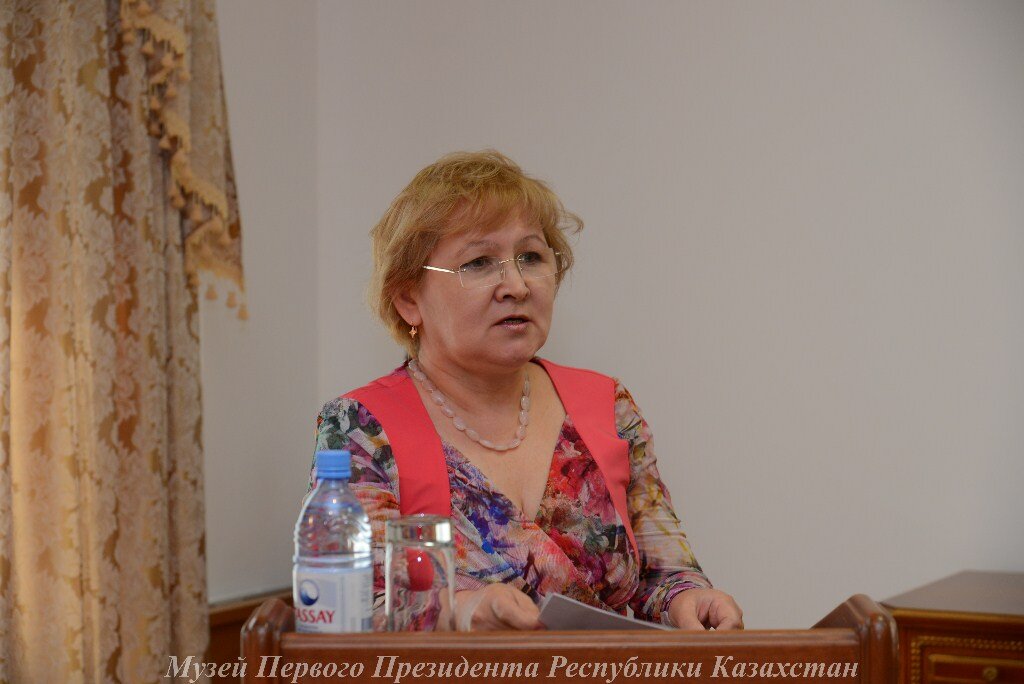
V. Malinovsky, a member of the Constitutional Council of the Republic of Kazakhstan, doctor of law, in his speech focused on the main stages of the formation of the Constitution of the Republic of Kazakhstan, and also activity of the Constitutional Council, noting that: «the Constitution of the Republic of Kazakhstan rationally combines and effectively sends the political, legal, organizational, ideological, international functions, providing progress, peace and harmony in society and the state».
The perception of the people of Kazakhstan initiatives of Leader of the Nation, including the Plan of «100 steps» for implementation the 5 institutional reforms outlined manager of sector of the Centre of strategic development and analysis of Administration of the President of the Republic of Kazakhstan, doctor of sociological sciences S. Konovalov.
B. Kumekov, professor of Eurasian studies of the historical faculty of the Eurasian National University named after L. N. Gumilev, doctor of historical sciences, academician of the National academy of sciences of the Republic of Kazakhstan, noted in his report that, the history of our state was formed over 2,500 years ago. According to the academician statehood traditions have deep roots and found reflection in the process of construction of independence of the Republic of Kazakhstan.
The 70th anniversary of the Great Victory in the Great Patriotic War found interesting reflection in the report of professor of the Eurasian national university named after L.N. Gumilyov, commander of the search party «Memorial Zone» M. Kusainov. On the basis of generally accepted definitions of military archeology, the scientist has developed its definition of the term. Also illuminated activities of search group «Memorial Zone».
It was noted that the role of the Museum of the First President of the Republic of Kazakhstan to study the issues of socio-political perspective and the phenomenon of Leader of the Nation on the example of project activities, scientific popularization, induced extensive research competence.
The participants of the «round table» noted that the achievements and successes of Kazakhstan during the independence years this heritage for future generations, a solid foundation for building a strong, independent and dynamically developing Kazakhstan in the XXI century.
Organizers of the conference are going to publish the collection of «round table» materials, which will include articles of the participants.
 |
 |
 |
 |
 |
The international scientific-practical conference «Polish diplomats in Kazakhstan (1941-1943)» organized together with Embassy of the Republic of Poland in the Republic of Kazakhstan took place at the Museum of the First President of the Republic of Kazakhstan on June 15, 2015.
Staff of embassy, foreign researchers - Hubert Chudzio, doctor of historical sciences of Pedagogical University named after the Commission of National Education in Krakow; Slawomir Kalbarchik, historian of Institute of National Remembrance of Warsaw; and domestic scientists D.M. Legky, N.V. Stepanenko, M.Sh. Gubaidullina, A.T. Kulbaeva, L.T. Isova, S.N. Mamytova, S.V. Eleuhanova representatives of archival and museum communities took part in the conference.
The director of the Museum of the First President of the Republic of Kazakhstan A. Sagyngali in welcoming speech noted: «Poland and Kazakhstan are joined with strong, centuries-old historical traditions. The fundamental elements of the Kazakh-Polish relations, the guarantee of their further development are many thousands of Polish Diaspora in Kazakhstan, the common of historical destiny of our peoples, as well as close spiritual, cultural and humanitarian relations. More than twenty years from the establishment of diplomatic relations between Kazakhstan and Poland took place in the atmosphere of stability and expansion of cooperation in various spheres of life».
Ambassador extraordinary and plenipotentiary of the Republic of Poland in the Republic of Kazakhstan Jacek Kluczkowski emphasized that, people in Poland highly appreciate the unique policy of peace and harmony held in Kazakhstan, thanks to which «all ethnic groups feel themselves here at home, can realize and reach their dreams».
During the international scientific-practical conference the participants discussed current issues of study of historical destinies and activities of the Polish delegatures - prototypes of Poland diplomatic missions during the Great Patriotic War on the territory of modern Kazakhstan.
Official, public lighting, this subject has received in the scientific research work of scientists - participants of the conference, which in the first introduced into scientific circulation classified previously archival documents.
Doctor of historical sciences Hubert Hudzio focused on historical prerequisites of appearance of delegatures and fates of deported Poles; also he noted that, «9 Polish delegatures of 19 operating on the territory of the USSR were founded in the Kazakh Soviet Socialist Republic (in the present Kazakhstan). Their headquarters were located in Almaty, Akmola (now Astana), Chkalov, Chimkent (Shymkent), Zhambyl (Taraz), Kustanay (Kostanay), Pavlodar, Petropavlovsk, Semipalatinsk (Semey)».
Dmitry Legky, doctor of historical sciences, professor of Kostanay State University named after A. Baitursynov outlined in his report the activities of delegatures of Polish embassy in Kustanay of Kazakh SSR (1941-1943). He said that: «a long time, until the beginning of the 21th century «military secret» was such fact (not mentioned in any researches), as the activity of the Polish delegatures and the formation of General Anders’s polish army in Kustanay region».
Nadezhda Stepanenko, senior lecturer of «Social and humanitarian disciplines» department of Aktyubinsk University named after S. Baishev, PhD, in own report about representation of Poland in Aktyubinsk during the Great Patriotic War (1941-1943) noted, that after the complication of the Soviet-Polish relations in 1943 all the Polish representation in the Soviet Union, including Kazakhstan, have been closed, and the documentation was eliminated. The surviving archival documents on the activities of delegatures in Aktyubinsk, can be considered as a historical success.
Polish presence in Almaty during the Second World War (1941-1943) was exposed on certain documents from archives of Almaty by M.Sh. Gubaidullina, professor of Al-Farabi Kazakh National University, doctor of historical sciences and A.T. Kulbaeva, docent of Al-Farabi Kazakh National University, Ph.D.
Docent of Al-Farabi Kazakh National University, Ph.D., L.T. Isova on the basis of archive materials told about features of the Polish diplomatic mission on the territory of the Kazakh SSR.
Director of the Research Centre of the Assembly of People of Kazakhstan and the Eurasian integration of Pavlodar State Pedagogical Institute, doctor of historical sciences, professor S.N. Mamytova in report gave attention to the history of the ethnic deportation, noting, that modern historians have attempted an objective, comprehensive assessment of the problems of forced mass evictions of people in Kazakhstan in 30-40-ies of the 20th century.
Analyzing the sources of the history of Poles on the territory of Karaganda region in 1941-1943, docent of Kazakhstan history department of Karaganda State University named after academician E.A. Buketov, candidate of historical sciences S.V. Eleuhanova emphasized the importance of their interpretation, validation and comparison of individual documents.
Summarizing, Ambassador extraordinary and plenipotentiary of the Republic of Poland in the Republic of Kazakhstan Jacek Kluczkowski thanked the administration of the Museum for the excellent organization of the event and emphasized the importance of the conference in the Museum of the First President of the Republic of Kazakhstan.
Organizers of the conference are going to publish the collection of conference materials, which will include articles of the participants.
 |
 |
 |
 |
 |
 |